
Minnesota Waldorf School Learning Tools: Fourth Grade
A peek inside the typical desk of a fourth Grade Student at the Minnesota Waldorf School.
All learning materials, including art, handwork and wood work supplies are included with school tuition.
Like all of our classrooms, you will not find computers or tablets inside the desks of our students. Instead you will find learning tools that give way to a deeper understanding of the world as our dear fourth graders build character, independence and curiosity.
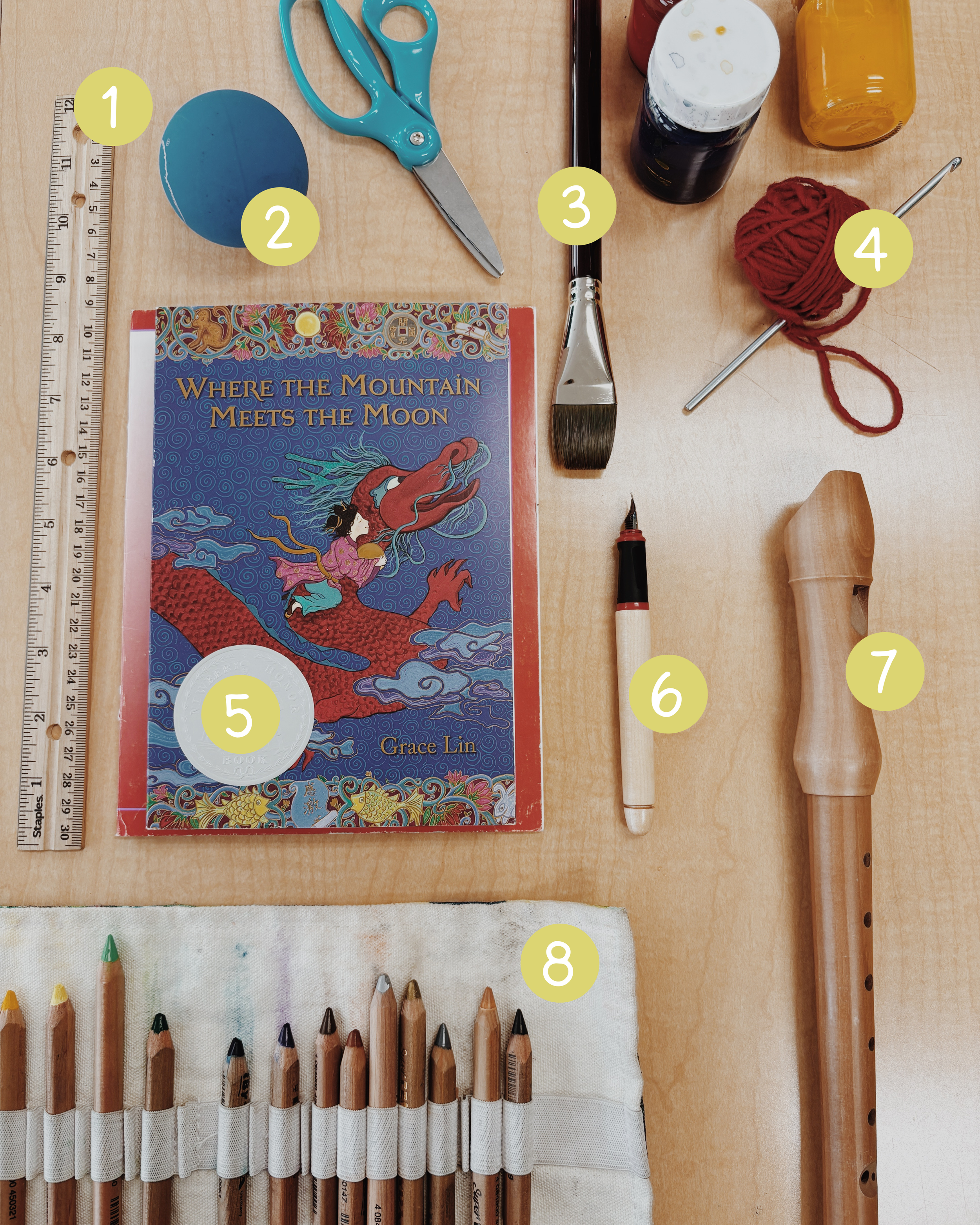
Ruler: Rulers are used by fourth graders to explore geography and support map making. Measurement is also used to connect math to practical applications.
Bal-A-Vis-X Ball: Morning Circle brings a variety of opportunities for movement, poetry recitation, mental math practice, dance, and group singing. The Bal-A-Vis-X ball is just one of many tools that students use to build and develop spatial awareness, rhythm, eye tracking, balance, and more. Through a variety of ball-bounce patterns and rhythms, including individual, group and partner work, students awaken their bodies and minds to start the day.
Painting Supplies
Animal drawings and watercolor paintings support themes found in their academic lessons. Painting in fourth grade introduces the exploration of contrasting moods, warm and cold, light and dark or sad and cheerful, allowing children to explore their inner feelings and find the forms that develop through these contrasts.Handwork Project
Research shows a connection between fine motor skills and brain
development, and handwork activities such as sewing, knitting, crocheting and cross-stitch
that challenge students to use both sides of their brain. Other skills reinforced by handwork include eye tracking, spatial awareness, crossing the midline, and numeracy. Minnesota Waldorf Students begin handwork projects in Early Childhood with simple sewing projects, beeswax modeling, and finger knitting.A Great Book
Reading skills in the fourth grade focus on building independence, fluency, and deeper comprehension through myth, folklore (like Norse myths), and stories. Students have the opportunity to read silently or aloud, either individually or in groups, based on the teacher's guidance.Fountain Pen
In our fourth grade class, fountain pens are introduced, often for cursive writing, to develop fine motor skills, proper grip, and mindful, lighter pressure for smoother, beautiful handwriting, encouraging a deeper connection to the writing process and improving letter formation compared to ballpoints.Wooden Recorder
Flute playing begins in the first grade and evolves each year, with third graders beginning to play the soprano recorder. Building upon previous years foundations, our time spent with the recorder this year emphasizes training of the ear and voice, working on creating a harmonious, joyful and rhythmic experience of being musical.Drawing Pencils
Waldorf students begin recording their academic lessons in first grade through main lessons books, essentially a handmade journal where they document their learning through writing, drawing, diagrams, and creative expression, replacing traditional textbooks and worksheets for core subjects. Crayons are the norm in first grade and the students transition to pencils in third grade; later on to pen and ink.