
First Grade at the Minnesota Waldorf School: A Journey Begins
Not only is entering first grade a magical transition for graduates of Waldorf kindergarten, but it’s also a fresh start and an excellent entry point for those who are new to Waldorf. Waldorf education places an emphasis on educating the whole child — emotionally, socially, and intellectually. In kindergarten, this means a focus on play-based learning and imaginative imitation in the homelike environment of the early childhood cottage. In first grade, however, the educational focus shifts to more explicit academic instruction.
In first grade, class teachers lay academic foundations on which to build in each subsequent grade. Students are brought closer to mathematics and language arts in developmentally appropriate ways that establish a lifelong love of and enthusiasm for learning.
At Minnesota Waldorf School, we encourage an educational practice intrinsic to most Waldorf schools in which the same teacher remains with a class as they rise through the grades. Teaching out of relationship is a core principle of Waldorf education, and at MWS, grades class teachers are hired with the expectation that they will teach their classes through multiple grades. Though historically the expected commitment for a class teacher in a Waldorf school has been eight years, many schools are changing their approach in light of the expanding demands of the classroom and curriculum. During the 4th grade year, teachers reflect on whether to carry their class through the upper grades or to cycle back to 1st grade. Enabling teachers to “loop” through the grades with the same group of students helps them to better understand and meet the needs of individual students and the class as a whole. Looping is just one piece of the beauty, intentionality, and focus on relationships built into Waldorf curriculum.
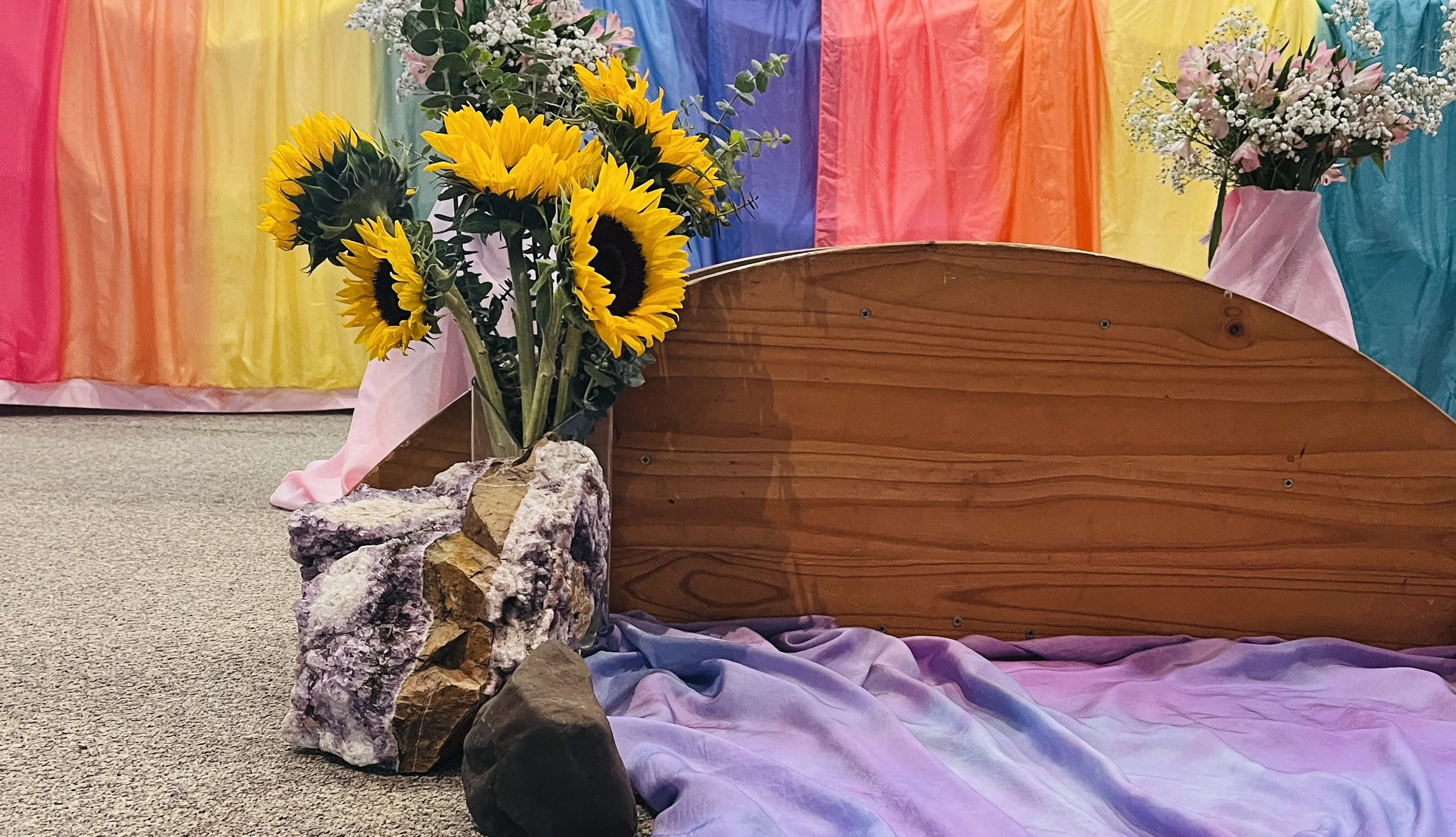
The Waldorf School Rainbow Bridge celebrates the transition from kindergarten to first grade.
It represents a child's move from the dreamy imaginative world of Early Childhood into structured academic learning. During this ceremony children walk across the school’s rainbow bridge to be welcomed by their new first-grade teacher.
On the first day of school, first graders begin their day in the care of beloved kindergarten teachers. At a ceremony that parents attend, the kindergarten teachers send each child over the rainbow bridge to meet their first-grade teacher. Some children skip and jump over the bridge made of wood, flowers, and draperies; others walk solemnly. Regardless of the manner in which each child crosses the bridge, an important transition has just been made. Entering first grade symbolizes a new beginning in a child’s educational journey. Developmentally, the first-grade child has newly acquired capacities emotionally, socially, and intellectually that the Waldorf curriculum recognizes and nurtures.
First Grade Curriculum
Taught by the class teacher, Morning Lesson lies at the heart of the Waldorf grades curriculum. Core subjects, such as history, language arts, science, and mathematics, are the focus of each daily two-hour period. Subjects are taught in blocks that last from three to eight weeks, allowing teachers to dive more deeply into each topic.
In first grade, Morning Lesson begins with twenty to thirty minutes of circle time. This transitional period of movement is filled with songs, rhymes, mental math, and other exercises that prepare the children for their Morning Lesson work. After circle time, the children take their seats, ready for the day’s lesson. Here, the children hear stories that will make up the content of their work. The class discusses and finds meaning in these stories. Led by their teacher, they delve more deeply into their understanding of the day’s lesson by expressing themselves through writing and drawing. Children develop care and discipline as they are instructed in writing, drawing, and form drawing. Class teachers encourage them to not only seek proficiency as they learn and practice these skills, but to seek quality, beauty, and pride in their work. After Morning Lesson, they eat a hearty snack (brought from home) and play outdoors before transitioning to their subject classes, including handwork, movement, Spanish, music, and art. First graders typically have two 45-minute subject classes each day before transitioning to lunch.
Afternoons in the first grade are kept deliberately relaxed to support the developmental need of first graders to still have intentional periods of play while growing academically. For our youngest elementary students, lunch is followed by recess and additional outdoor time. First graders end each day with a rest period that includes story time. Afternoons in the first grade are kept deliberately relaxed to support the developmental need of first graders to still have intentional periods of play while growing academically.For our youngest elementary students, lunch is followed by recess and additional outdoor time. First graders end each day with a story time and rest period.
Mathematics
In mathematics the goals are recognition of number qualities, flexibility, an understanding of the four processes (addition, subtraction, multiplication, and division), the understanding of basic facts and initial steps towards their memorization, noting patterns in the verbal and written form of basic facts, and an approach to the concept of place value experienced through comparison of Roman and Arabic numerals. There is much activity in the lesson and in the circle that involves counting and counting games, identification of numerals, and the writing of numbers. Images from nature and practical situations provide the basis for active practice with the four processes. These stories serve as the introduction to the processes and as a place to find inspiration for story problems. With story problems, the children are engaged in the imaginative activity of carrying out the process, at first with manipulatives and then in drawings. These story problems are connected with the rhythmical number work of the circle and the written numbers and symbols for the four processes.
Reading
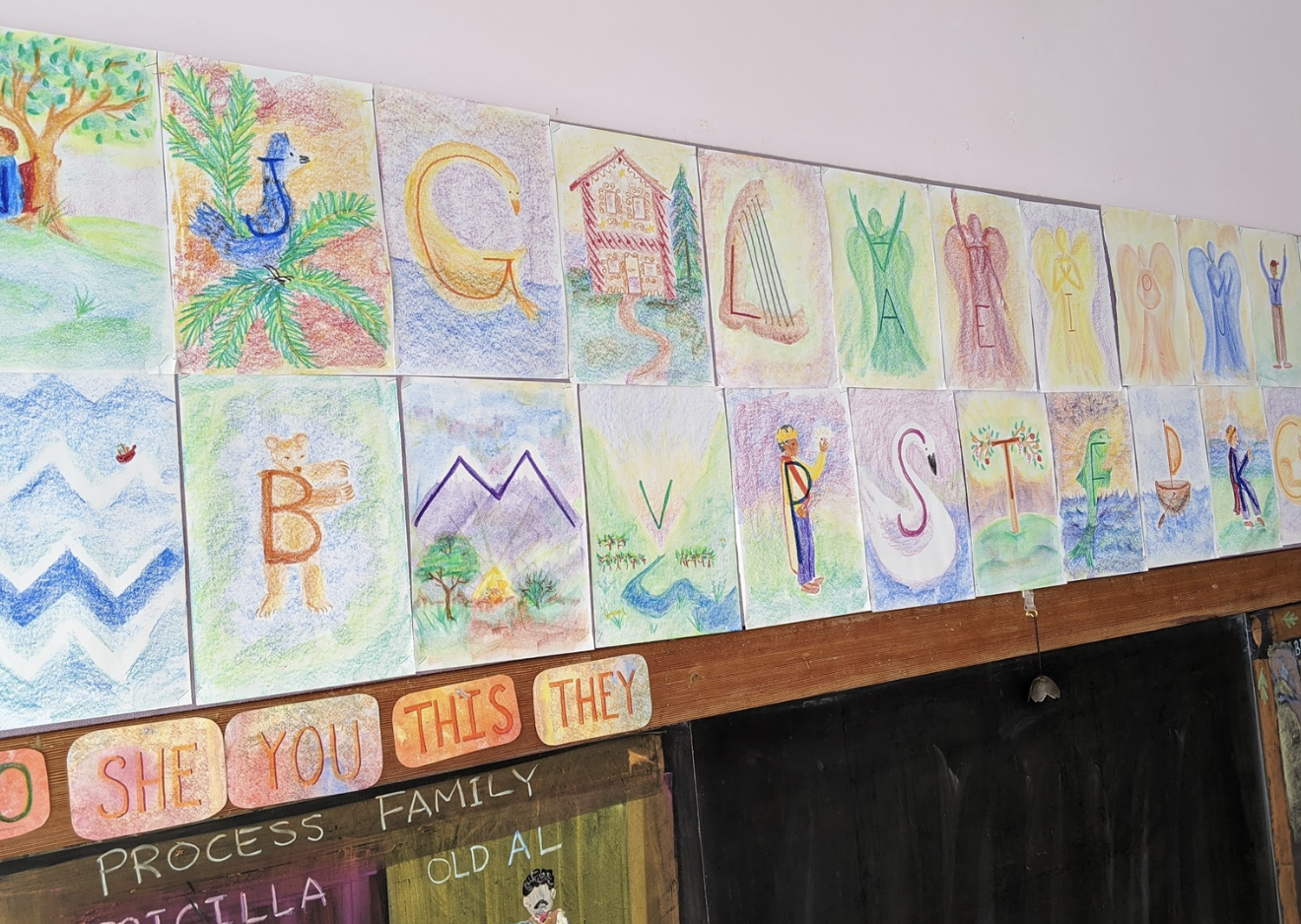
The formal introduction of reading begins in first grade when the teacher draws on the archetypal moral images of fairy tales to illustrate the consonants. For example, the king steps forward, brandishing his sword, and we recognize the letter K. Vowels are related to soul gestures and are also expressed in pictures. We engage the child in movement: walking, tracing the letters on backs, in the air, with our feet, etc. Writing precedes reading, which is a far more abstract activity. The children learn to read by reading chorally and later individually what they have written or what the teacher has written on the board. The content is familiar and meaningful. Several methods of reading education are integrated: phonics, whole word recognition (sight words), and contextual clues. The children master the alphabetical order of letters.
Writing
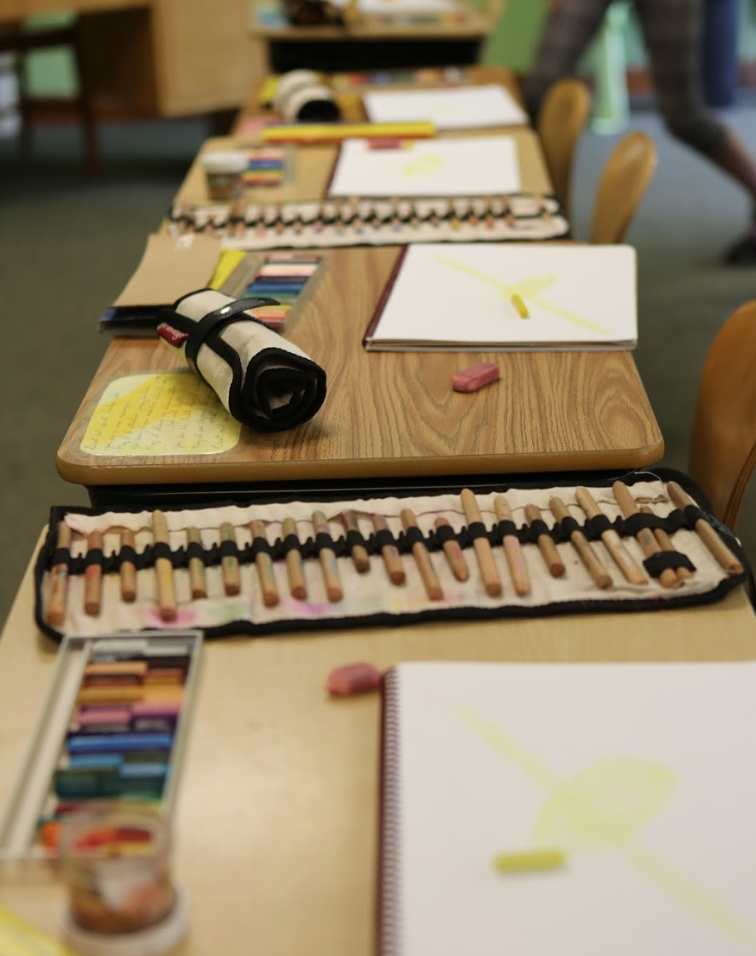
In first grade, drawing precedes writing as writing precedes reading. Through form drawing, the children experience the use and expression of the straight line and the curve out of which all letters are formed. Once this has been established, then the actual forms of the letters are derived out of story-based, orally presented world imaginations; thus, the children experience them as being part of the world, not as mere abstractions. The teaching method is from whole to part. Thus, from story image to alliterative verse, to specific image word, to abstracted representative letter, the child is led to a comprehension of the word and the alphabet. Typically, printed capital letters are introduced first and later lower case at the end of the year or the beginning of the next. The children write through imitation of the teacher’s writing. Verses and story summaries involving their active participation are transcribed into morning lesson books. Formal grammar is not taught but is experienced through the articulate speech of the teacher and the retelling of stories by the children. Both vocal and consonantal sounds and blends, and their representative letters are worked with in alliterative speech exercises, body gestures and movements, and drama. Emphasis is placed on posture, pencil grip, and neat letter formation.
Art and the Sciences
Reading, writing, and mathematics are the primary subjects of the first grade. During first and second grade, the children are told a series of detailed nature stories that embody the science to which they will later be directly exposed. These nature stories are vivid, illustrative pictures of the processes of plants, animals, and the natural world. In kindergarten and the early grades, geography comes in the form of exploration and discovery of the world of nature, earth, water, air, seasons, and natural processes. These processes are not named or brought to the child in an abstract or intellectual way but rather through nature stories and tales. The water cycle and the ecology of the earth are experienced through characterization of sprites, nymphs, and gnomes and the elements of the natural world that express their nature through songs, poems, and games. Also integral to the first-grade experience are the arts of painting and music. Painting is a weekly activity. Painting with watercolors brings much to the children. Through the work with this technique, a range of growing skills is developed that become the core of individual expression. As part of everyday trips through the hall, in circle, and with blessings, the children sing. Singing songs together as part of daily and seasonal rituals continues that element established in the kindergarten. The playing of pentatonic flutes becomes increasingly a part of the day—not for proficiency, but for the social aspect of making music together.
The first grade presents a class play toward the end of the school year. The play is developed through the morning circle work and is often presented to parents in a circle format rather than a traditional staged play format. Parents are invited to the performance, but it is not performed for the school.
At Minnesota Waldorf, the first grade year represents a significant shift in the students’ school journey. First graders receive a rose from an eighth grader on their first day of school. Thus begins a year long relationship with an older ‘buddy’ who has experienced all that a Waldorf elementary through middle school experience, with its scaffolded curriculum, has to offer.
Meet Elizabeth Lenarz , Minnesota Waldorf School’s Class of 2035’s first-grade teacher, and learn a little about her approach to teaching first grade.